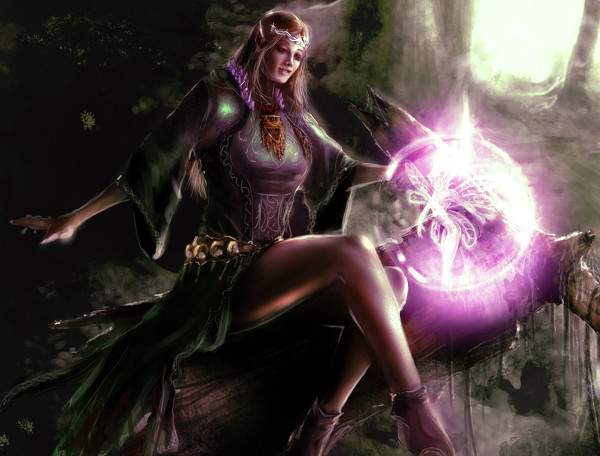
Races of Mythania
Apart from dragons, spirits, and magical beings, there are ten major species (or races) in the world: Humankind, Eldrien, Scaithi, Dworghs, Giants, Ogrim, Goblinkind, Tricarians, Kaffrians, and Marsids. Only recently have scientists classified the races by taxonomy, and in so doing have discovered that most intelligent species are in fact sub-species of the hominid family. These include Humankind, Eldrien, Scaithi, Dworghs, and Tricarians (also known as triclopes). Ogres, giants, and goblins are also hominids, and while many conservative scientists still refuse to recognize them as such, the simple fact that ogres and goblins can cross-breed with humans is proof of their common lineage. The remaining intelligent species are Kaffrians and Marsids. Kaffrians are of the family felidae (feline), while Marsides are of the family of muridae (mouse).
Capitalization of Race Names
The names of races may either be capitalized if they are treated as proper nouns, or lower cased if they are treated as common nouns. Each race that possess a distinct culture, language, and heritage are referred to in proper form and are thus capitalized. These include Eldrien, Dworghs, Scaithi, Ogrim, Tricarians, Kaffrians, and Marsids. However, humans, goblins, giants, and ogres (in common usage) are lower cased. Many races also have common names in addition to their proper names: Eldrien may be called "elds", Scaithi may be called "darklings", Ogrim are most often called "ogres", and Tricarians are typically referred to as "triclopes". Humankind may be capitalized when formally referring to humanity as a race, often in relation to the race of Eldrien or Dworghs.
Humans
The Kindred of the CityHumankind (common name "humans") constitute the most common race in the world. Humans dominate the major kingdoms and fill all the prominent roles in society. In and of themselves humans are a diverse race, and among their kind are countless ethnic groups. The men of Tilsha, Alran, Armillia, and Glaven are fair-skinned with dark to light-colored hair. The men of Suddaea, Canath, and the other desert kingdoms have darker skins and have adapted to live in the harsh desert environment. Very dark-skinned humans live in the Mesoria regions of Celaphania, and Orientals live in the Zhonghua subcontinent. The humans who live in the Dark Kingdoms of Tarrona are of mixed ethnic background and hail from all over the world, including the barbarians of the Frozen North, many of whom are dark skinned, though some are also quite pale.
Other races sometimes refer to humans as "Sons of the City" or "Kindred of the City". This is because humans build great cities and have lived in heavily urbanized environments for thousands of years, which is something that many other races dislike.
Dworghs
The Kindred of the EarthDworghs (common name "dwarf") are an ancient people of great strength and stamina. Though shorter and heftier than most humans, dwarves are not to be underestimated. They can see well in darkness, as they have adapted to living underground and in dark places. Dworghs are not nearly as common as humans, but like humans, they too build great cities and empires. They are greatly renowned for their fine craftsmanship and knowledge of metallurgy and mechanical things, and are often found in cities as blacksmiths or craftsmen.
Dworghen history extends back far before the Age of Marada, to the time of myths and legends. Dworghs insist that their lore, no matter how fanciful or fantastic, is literal fact. As they have it, the gods made their people smaller than the other races, for they were the People of the Earth, and thus made to live closest to the earth. They were hardworking and practical, and served the Gods of Light with great devotion. But there were other races with high ambitions who did not want to serve the gods or mine the earth. Instead, they grew upward, their heads ever-looking to dreams they could not achieve. And so, like their egos, they grew taller and became men and giants. The giants became so tall their bodies overpowered their mind, and they grew dumb and slow-witted. Though men found wisdom, they remained arrogant and ambitious, and in their arrogance waged terrible wars. But the Dworghs, steadfast and loyal, remained as the gods had created them - the Sons of the Earth.
Today, Dworghs can be found all over the world, but they center mostly in Nuram and Celaphania and are scattered throughout Tarrona. The island of Nuram is controlled by the Dworghen Kingdom, ruled by King Kobarj and the mighty Novanus Mercantile. Here they have enslaved many of their own people, as well as humans, Marsids, and goblins to work in the mines of the great volcano Novanus--the sole source of a precious ore called Novarite. For this reason, Dworghs are not looked highly upon. Most Dworghs, however, are not like their ruthless ruling cast.
Dworghs stand an average of 45 to 50 inches tall, and adult males weigh between 140 and 170 pounds. Many of them suffer from obesity, but even those who do not may seem disproportionate to humans. Males usually have a great deal of facial hair, and often make a big deal about grooming their beards. Females are a bit smaller and lighter, and not nearly as hairy. Their average life span is similar to that of humans, though a few have reached the age of 140 years. Dworghs once had many languages and dialects, just as humans do, but for the past few hundred years have adapted human languages as a result of trade and cultural exchange. Only elder Dworghs and scholars still speak the old tongue.
Eldrien
The Kindred of the LightThe Eldrien (common name "elds" or "eldlings", but is sometimes considered offensive) are an ancient race of people whose close kinship with nature has never waned. There are many myths and legends about the Eldrien, but they are neither gods nor immortals, as many of the ancient myths portray. Even so, elds possess extraordinary powers of magic and live for an exceptionally long time. Their average life span is 300 years, with an upper limit of 400 to 450 years.
In legend, the Eldrien were often referred to as the Ancient Ones, the First Ones, or the Elder Ones, and were frequently mixed up with the faeries and other nature spirits such as sylphs and dryads. Many believe they were the first and highest hominid race, from which all other races evolved following the God Wars. There may be some truth in this since Eldrien are believed to have developed the first written languages, although recent archaeological evidence has begun to cast some doubt on this. Even so, Eldrien view themselves as superior to humans, which is an idea that most humans resent.
At maturity, the age they call "Aegeir" (around 30 years of age), an eldling will stand about 70 inches tall, have sharp facial features and pointed ears, and often wear clothing patterned with earth and forest colors. They appear physically unaging for another 80 years, after which they transition into their middle years, known as "Meadeir" (age 100 to 200), often growing beards, gaining wrinkles, and getting a bit heavier. Females do not change considerably during their Middle Years, but do become taller and more delicate, and though they lose some of their youthful beauty, they also grow wiser and more regal.
The third period of their lives begins around the age of 200 and is called "Eildeir", which means the Elder, or Elder Ones, from which the name of their race, "Eldrien", was itself derived. At this point they will begin to show their age, although their mental and magical faculties continue to increase. By the age of 300, males have yellowish skin, a long wizened face, little body hair, and tired, sunken eyes. Females can be best described as "having the appearance of a wizened queen, elderly yet still possessing a wisp of youth in her eyes". Most die around the age of 350 to 400, but some have lived as old as 450, and legend tells of great kings living for a thousand years.
All Eldrien have a magical alignment with the spirits of nature. Though they dislike open warfare, they are not pacifists. Eldrien will fight to defend themselves, their loved ones, and their villages from any hostile forces. They dislike technology and industry, as they find it destructive to nature. Most Eldrien follow the ancient Ultic religion, and worship Lureatha, Dagdera, and Curragwn as their chief deities. Eldrien priests must shave their heads, but priestesses have no such restriction.
Scaithi
The Kindred of the ShadowThe origin of the Scaithi (common name "darkling") is today a matter of great debate, but archaeological evidence shows that Scaithi first appeared on Tarrona at the same time as the Eldrien, and that the two races parted company about 5,500 years ago. There is little question that the Scaithi and the Eldrien are closely related. The most striking difference is skin color, which for Scaithi is dark gray in hue, though their hair and eye color can range as widely as it does for Eldrien. Many humans and Eldrien consider Scaithi to be "dark elds" who have turned to evil and darkness--hence their common name of "darkling". However, this notion is unfounded and unjust, for while many Scaithi are cold and apathetic, only a few are truly evil.
Scaithi dislike sunlight, and although they can tolerate sunlight they prefer dark, dimly lit places and have a much higher tolerance for cold than Eldrien. This being the case, they have found the northern lands of Tarrona much to their liking. They cannot abide desert environments, or any hot, dry, sunny clime, for that matter. On the other hand, they are much more urban than Eldrien, fearlessly taking to human cities, and seem quick to embrace the innovations offered by the new era of industry. This comes at a price, however, and many Scaithi have lost their connection with nature, in turn abandoning natural magic for astral magic and technology.
For Scaithi (as well as Eldrien), the two most significant historical events were the First and Second Battles of Moytura. These battles took place in the land that is now Phana during the Age of Keshim, when the united armies of Men and Eldrien fought the armies of Scaithi and Ogrim. Though the First Battle of Moytura ended in a stalemate, the Second Battle saw the death of the Scaithi King and their crippling defeat. Following this defeat the Scaithi were forced to withdraw deeper into northern Tarrona, where they have since remained.
Scaithi are today allies with the ogres, and are considered to be part of the Grand Imperium. Their kingdom, located in northern Darmania, is known as Tir Scaith, but their presence is extensive throughout Kendes and parts of Kaldea, as well. The city of Caldred is the capital of Tir Scaith, where the Scaithi King rules from his dark fortress of Glas'krak.
Giants
The Kindred of the HillsGiants are a hominid race of great size, typically twice the height of a human and often four to five times as heavy. For the most part they are dumb and slow-witted, but some have intelligence comparable to humans and Dworghs. Despite the tendency of humans and Dworghs (indeed, most races) to disregard giants as "monsters", this could not be further from the truth. Though it is true that giants tend to have a lower intelligence, they can be skilled craftsmen; the more intelligent ones (who can be as brilliant as any human sage) are often competent in languages and leadership, becoming the chieftain, medicine man, or lore-keeper of their tribe. Giants can make armor and weapons, but their skill in metallurgy is limited to lead, iron, copper, and bronze, and they rarely add ornaments or artistic flourishes to their works.
Mountain giants are probably the most common of all giants, and live in the Carsovian Mountains and the Mountains of Fire and Ice. They can also be found in Northithia and the Barrier Mountains of Celania. Mountain giants are generally more intelligent than other giants and are competent enough with metallurgy to sufficiently arm their people. They also mine gold and precious jewels, which they trade with humans and ogres for other goods. They typically have a great deal of hair and wear the pelts of animals for clothing. Their average height is about 14 to 16 feet, and their weight between 1400 and 1600 pounds. They make fierce warriors, and many can be found as mercenaries in the armies of the Dark Kingdoms.
Ogrim (Ogres)
The Kindred of BakmusHumans have long considered ogres to be nothing more than large and dangerous goblins (sometimes even calling them "hobgoblins"), but this could not be further from the truth. Ogres stand around 75 inches tall and weigh 300 to 400 pounds. They have dark-reddish flesh tones and a great deal of shaggy hair, most of it coming off their head, neck, back, and arms.
The origin of the Ogrim (as ogres are properly termed) is somewhat of a mystery. Until the War of Golla and Marada, they could only be found on Tarrona. At that time, Scaithi, Ogrim, and human kingdoms of northern Tarrona regularly clashed with humans and Eldrien in southern Tarrona. The two major battles of the period were the First and Second Battles of Moytura, when the Ogrim and Scaithi armies were at last driven back to the Carsovian Mountains, ending the Second Age of Darkness. They found their home in the Frozen North alongside giants and goblins, whom they managed to subjugate and enslave (though giants served more as mercenaries and paid workers). With the help of their Scaithi allies, the Ogrim became proficient in metallurgy, magic, astrology, and even alchemy and philosophy. During the War of Golla and Marada many ogres joined the forces of Golla, but the end was cataclysmic for both sides, and a new dark age cast its shadow across the world. In the terrible Endless Winter that followed, ogres and Scaithi prospered. Ogres also appeared on Celaphania around this time, but never in great number.
Humans and ogres warred with one another in the centuries that followed, but humans gained the upper hand because of their vast numbers and superior technology. In modern times, ogres have become increasingly more sophisticated. There are now ogre merchants and traders, and they have their own ships that sail the Sea of Isles. Ogre magic is primarily shamanic, and their alchemy is chiefly concerned with metallurgical sciences. As such, ogres can forge steel that rival that created by Dworghs.
Ogres have their own gods, but their religion has spread and mixed with human religions to some extent. Today they worship several Elinican and Ultic gods, including Kromal, Mitor, Feronia, and even Chazonas, as well as those of their own lore. Bahgmod is the God-Chief of the Ogrim. Some humans in the Frozen North may also worship this deity, who is known to men as Bakmus.
Goblins
The Kindred of the WretchedGoblins are nasty and war-like hominids, standing a good foot shorter than humans, but with lanky, disproportionate arms. They are mostly hairless, have sharp teeth, pronounced canines, a long-pointed noise, and tapering ears, and are either forest green in color or dark brownish-red (red and green goblins are distinct sub-races). Goblins are so different from other hominids that, until recently, they were widely considered nothing more than monsters. In recent years, however, scientists have managed to piece together the disturbing evidence that Goblinkind constitute a hominid species.
The great majority of goblins (red or "dark" goblins, as they are called) are concentrated in northern Tarrona, in the Dark Kingdoms and the Frozen North. Green goblins (also called forest goblins or woodland goblins) can be found in the forest lands of Tarrona and in all regions of Celaphania, especially the Azanian Jungle. Goblins are considered a nuisance and a threat to civilization in all regions of the world except in the Dark Kingdom, where they have been enslaved by ogres and Scaithi. In the Dark Kingdoms, goblins are used as cannon-fodder troops to help fuel the war machine of the Grand Imperium. Goblins stand approximately 50 to 55 inches tall with lanky limbs and large yellow eyes.
Tricarians (Triclopes)
The Kindred of the StarsTricarians (common name "triclopes" or "triclops" in singular form) are very similar to humans in appearance but for one outstanding feature--their third eye. This third eye is centered on the forehead about an inch above the brow, with the tear duct on the right or left side depending on whether the triclops in question is right or left handed. Under normal conditions their third eye looks just like the other two, but when the triclops is using his psychic powers the eye glows blue, white, green, or even red (or a variety of other colors) depending on his mood or the extent of his powers. The eye can be covered by jewelry, headbands, or a large hat or helm, and when concealed it is almost impossible to distinguish triclopes from humans. Covering the eye, however, also hampers their powers.
Even so, Tricarians have a few subtle features that differentiate them from humans. Their facial features are more angular, most noticeably in the nose and chin, and their canine teeth are also slightly more pronounced. Their hair color ranges from black to light brown, to various hues of red and blond. Their eye color also ranges from dark brown to hazel, blue, and green.
Tricarians are hated by many other races due to the Great Tyranny, when the Triclopes Lords lead the forces of Tricar in a bid to conquer and enslave the known world. Others fear them because of their significant psychic abilities. Nevertheless, nearly 200 years have passed since that war, and the old hatreds have begin to fade. Many reasonable humans and Eldrien no longer hate triclopes, and they have at last begun to reintegrate themselves in the world stage. Most who leave Tricar endeavor to follow local laws to the letter, both to help clear their long tarnished name and keep out of trouble.
Triclops Lords were the most powerful of all the Tricarians, and trace their direct, noble lineages to their powerful, but long forgotten demi-god ancestors. Triclops Lords are near-immortal and extremely powerful, possessing tremendous telepathic and telekinetic powers. Before the Great Tyranny, the Tricarian nobles came from many different families, but these family lines were wiped out when Emperor Ptakn rose to power. During the War of Tyranny, the only remaining Triclops Lords were blood-related to the House of Ptakn. Currently, the Triclops Lords are thought to be extinct--their lineages having been extinguished in the War of Tyranny .
Kaffrians
The Kindred of MatetKaffrians are a race of feline humanoids native to Celaphania. Both males and females are the same height and stand a bit shorter than humans, being 60 to 65 inches on average, and significantly lighter in weight (between 90 to 120 pounds). Kaffrians are completely covered in short fur that is usually gray or tan, but their coloration and patterns vary depending on family lines.
Though not as strong as humans, Kaffrians are faster and more dexterous and can see in near-total darkness. Kaffrians also have a tail that is about two feet in length, but they generally keep this tail tucked away in their clothing. Their facial structure is feline, with large cat-eyes, twitching ears on top of their head, and long whiskers on the front of their face. Their mouths are small and their sharp teeth are not made for chewing or grinding. As a result, Kaffrians are finicky about what they eat and tend to prefer delicately prepared foods. Their favorite food is fish, and, despite the common misconceptions, they have a strong disdain for eating rodents, considering them to be filthy. Kaffrians are also obsessive about their appearance, grooming themselves almost constantly. They love wearing silk, jewelry, and bright clothing.
The Kaffrian language is sharp and high-pitched, and the native script is hieroglyphic. Some humans refer to Kaffrian as "Meowese", but Kaffrians consider this term derogatory. After the War of Tyranny the Kaffrian hieroglyphic writing style, called kaloglyphics, was all but lost, and the current generation is almost completely ignorant of both written and spoken Kaffrian. Though the old Kaffrian traditions are in decline, some still hold on to the Old Ways, honoring the Mother-Goddess, Matet, and the Sky-God, Amanata. Some Kaffrians have converted to the Archidoxy, and many are simply nonreligious.
At one time the Kaffrians were a powerful race, and had an empire that spanned the Medrean Sea and most of Mesoria. During the Age of Keshim, and for nearly 500 years after, the Kaffrians ruled in equal power with Keshim over the civilized world. However, Ancient Kaffrica began to decline as Elinica grew to become the Empire of Marada. Along with Marada, Kaffrica was lost in the cataclysmic War of Golla and Marada.
As the world struggled from the ashes, the Kaffrians rose once more. During the Age of the Imperial Republic, the Kaffrians experienced a great cultural renaissance lasting from about 620 to 840 CA. During this time they attempted to rebuild Ancient Kaffrica from the scattered ruins and crumbling pyramids that remained. The Kaffrians also built new pyramids and shining temples in a style that hearkened back to the glorious age of old. They constructed great monuments, towering statues, and marvelous works of art and craftsmanship. At the height of the New Kaffrian Empire, just before the Great Tyranny, their influence stretched across the globe--from Celaphania to Tarrona, and from Megonia to Tai-tsing and Nanshin. Unfortunately, it all was about to come to a tragic and bloody end.
The Kaffrian Empire was a merchant power, not a military power, and the triclopes wanted that great wealth for themselves. It has been estimated that Kaffrians suffered the greatest proportional loss during the Great Tyranny. As Kaffrians made poor slaves, the triclopes simply used them for sport and entertainment. By the end of the war, nearly three-fourths of their kind had been killed. Since then, Kaffrians have managed to recover both in population as well as economic power in the centuries that followed, yet thus far they have not been as great a world power as they once were. As well as being known as famed sea farers and traders, Kaffrians are also regarded as true freedom fighters. Having nearly met extinction in the Great Tyranny, many have now joined in the war against the Dark Kingdoms.
Today Kaffrians have a large population in Mesoria and throughout the Medrean nations known as the Kaffrian Alliance. They can be seen mingling in human society and are as common as Dworghs in most cities, especially port cities. Kaffrian merchants make some of the shrewdest traders on the seas today, and their sleek clipperships are the swiftest vessels of their size--some swifter even than steamships.
Marsids
The Kindred of the MarshMarsids are a race of intelligent, bipedal rodents native to the swamps and jungles of Mesoria. Marsids stand around 60 inches tall, weigh about 160 pounds, and walk with a hunched-over posture. Fur covers their whole body, except for their long pink tail, and this fur tends to have a range of color from white to gray, or from brown to black, and various patterns composed of these colors. Marsids have small hands and very large feet; they prefer to go barefooted whenever possible. Their heads and faces are "rodent-like", with a protruding snout, whiskers, prominent ears, and beady black eyes. They make up for poor eyesight with a keen sense of hearing and smell. Most are well dressed, love colorful clothing, and keep their pelts clean and well groomed.
Marsids have never had a significantly powerful civilization, but they do have a strong sense of social belonging. Traditionally, Marsids lived in clans of a few hundred members scattered throughout the jungles and swamps they inhabited, a fact which may have saved them from the Great Tyranny. During the War of Tyranny, the vast majority of Marsids either lived in, or retreated to, the deep jungles of the Azania and the Mesotrocians, where not even the Tricarian army wished to pursue.
Today, most Marsids are found in Celaphania (in Mesoria), though a few also live in western Tarrona. They have extensive territory in Punta and the Azanian Jungle, which holds a loose tribal confederation known as the Marsid Freehold. They want little to do with human affairs, and the vast majority of their people never leave their tribal homes. Those that do strike out on their own are usually more intelligent, independent, or adventuresome.
Over the centuries, some Marsids have settled down in cities and co-exist side-by-side with humans, Dworghs, and Kaffrians. They still prefer dim, damp areas, and their homes are often built as great cellars in which with the above ground "house" is nothing more than an entrance parlor. Urbanized Marsids make their living in the same occupations as humans and Dworghs--craftsmen, sailors, soldiers, guards, farmers, blacksmiths, and even scholars. Some Marsids learn to use magic (usually natural magic), and well-educated Marsids can also learn alchemy, astrology, and astral magic. Curiously, because of their acute sense of balance and innate spatial awareness, they make superb aerodyne pilots; though few Marsids are daring enough to take to the skies, those who do can quickly outclass even the best human aces.